
 +44 (0)151 548 9000



The sash clamp has been a workshop staple for generations. But as production demands grow and quality standards tighten, many manufacturers are discovering that modern panel clamping systems don't just match old sash clamps – they leave them far behind.
If you've ever spent time wrestling old sash clamps across a workshop floor, hunting for the ones that still apply even pressure, or walked in the next morning to find a glue joint that hasn't cured flush, you'll already know the problem. Sash clamps are simple, but simple doesn't always mean effective – particularly when you're laminating panels, stair strings, worktops or door frames at production volume.
This article looks honestly at the limitations of traditional sash clamps and explains why an increasing number of joinery, staircase and furniture manufacturers across the UK are switching to purpose-built panel clamping systems – specifically the JLT Panel Clamp and the Taylor Rotary Clamp Carrier, both exclusively available from JJ Smith.
The Problem with Sash Clamps (That Nobody Talks About)
Sash clamps have served woodworkers well for a long time, and for certain one-off or hand-craft applications, they remain perfectly adequate. But for any joinery or furniture business operating at scale, the cracks start to show quickly.
The most significant issue is uneven pressure distribution. A sash clamp applies pressure from one jaw at a time. Unless you're using opposing clamps and positioning them with considerable care, you'll get localised pressure points rather than an even clamping force across the full panel. The result? Bowing, buckling, and glue joints that look acceptable on the surface but fail in service.
There's also the matter of workshop space. A set of sash clamps in active use takes up an enormous amount of floor and bench space. When they're not in use, they're rarely stored efficiently and they end up leaning against walls, hanging from racks, or scattered across the floor where they become a trip hazard and a bottleneck.
Then there's the issue of consistency. In a production environment, consistency is everything. Sash clamps, particularly as they age and wear, apply different pressures – meaning your team can never be entirely confident that every glue-up will come out the same. When you're manufacturing staircases or bespoke joinery where quality is non-negotiable, inconsistency is simply not an option.
What a Modern Panel Clamping System Actually Does Differently
The JLT Panel Clamp was designed from the ground up to solve exactly these problems. It's not a sash clamp with extra features; it's a fundamentally different approach to clamping laminated components.
The Patented 'Equaliser' Clamp Arm
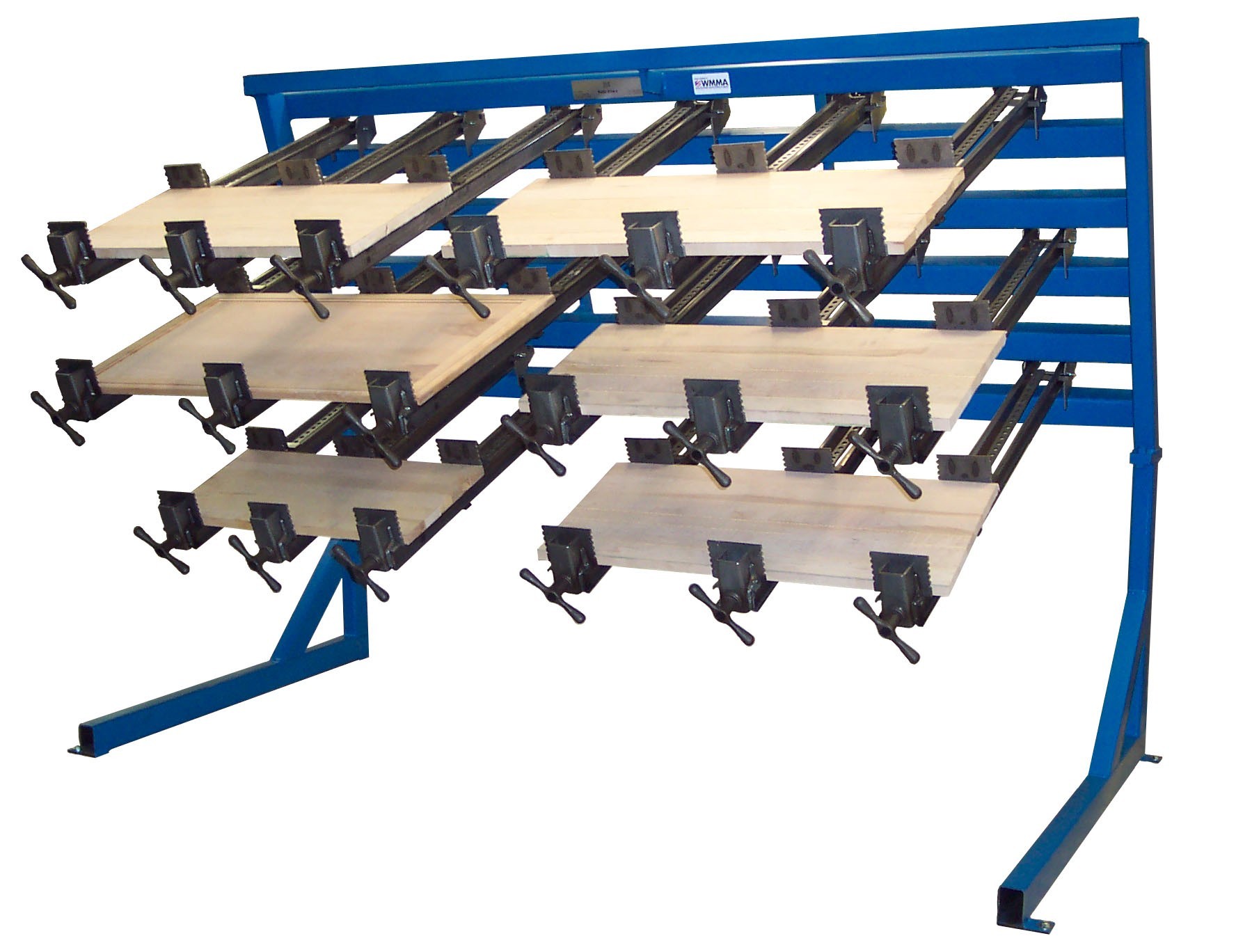
The headline feature of the JLT and the technology that also runs through the Taylor system, is the patented 'equaliser' clamp arm. Unlike a conventional sash clamp that applies pressure from a single direction, the equaliser design applies equal pressure simultaneously from both the front and rear jaws.
This might sound like a small difference, but the impact on joint quality is significant. Equal bilateral pressure means your panel is being compressed evenly from both sides; which produces a tighter, more consistent glue line, and dramatically reduces the risk of the panel bowing or shifting during the cure.
JLT Key Technical Specifications
- Designed to achieve up to 3,000 lbs of clamping pressure per clamp arm
- 115mm wide jaws for large, even clamping pressure area
- Jaws toed in 1° to counteract panel bowing and buckling
- Draw bar maintains full pressure as glue dries and panel shrinks
- Standard arm opening of 1015mm (40"), up to 1320mm (52") available
- Robotically welded for precision and uniformity
Maintained Pressure Through the Full Cure
One of the subtler but genuinely important innovations in the JLT design is the draw bar mechanism. As any experienced woodworker knows, wood moves – and during the gluing process, the panel will shrink a small amount as the glue dries. With a conventional clamp, that shrinkage can result in a reduction in clamping pressure at exactly the moment you need it most.
The JLT's draw bar acts like a spring, stretching when pressure is applied and automatically compensating as the panel shrinks during the cure. The result is that full clamping pressure is maintained throughout, from the moment you close the clamps to the moment the glue has fully cured.
Space-Saving Design
The JLT frame is designed so that clamp arms can be hung vertically when not in use. This is one of those features that sounds minor until you've experienced it and then it transforms how your workshop operates. Instead of sash clamps scattered across every available surface, your JLT system takes up a clearly defined footprint, and the clamp arms are stored neatly within that footprint when not clamping.
When You Need More: The Taylor Rotary Clamp Carrier
For manufacturers whose production volumes have grown beyond what a static panel clamp can comfortably handle, the Taylor Rotary Clamp Carrier represents the next step up.
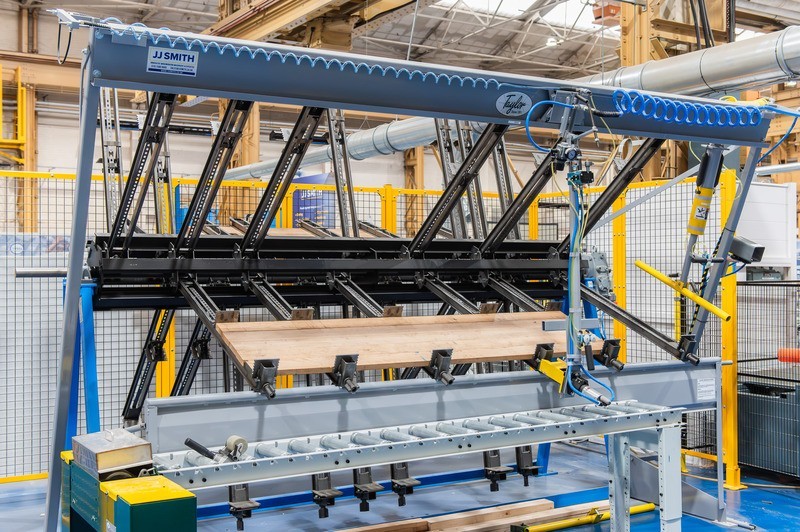
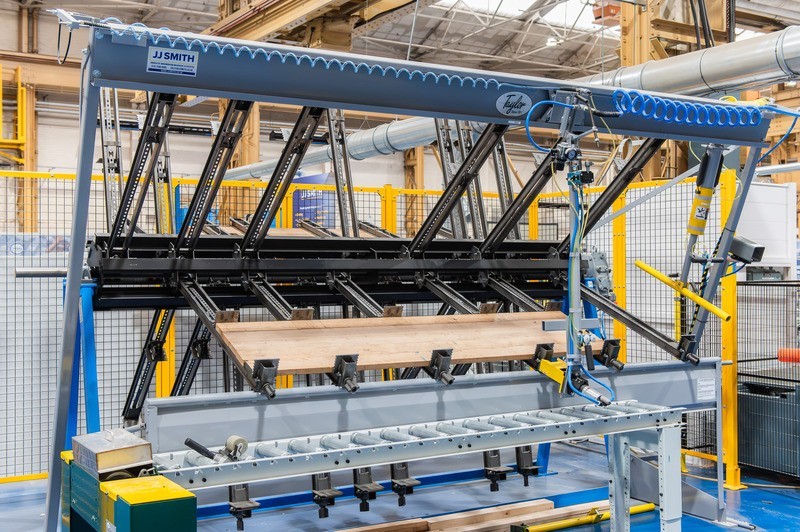
The Taylor system uses the same patented equaliser clamp technology as the JLT (so you get the same quality glue joint) but applies it within a fully configurable rotary carrier system. Working lengths from 2.5m up to 6.3m, with up to 30 sections, means the Taylor can handle significantly higher volumes than a panel clamp setup whilst maintaining that consistency of output.
Crucially, the Taylor is highly configurable. It's available in standard manual operation, semi-automatic, or fully automatic pneumatic or hydraulic systems, meaning you can specify a system that matches your current production and scale it as your business grows. The modular design also makes it straightforward to maintain, with parts and support available through JJ Smith.
Who Should Be Considering the Switch?
The manufacturers who benefit most from making the move to a JLT or Taylor system tend to share a few common characteristics:
- They're producing laminated components regularly (panels, worktops, stair strings, doors, or joinery sections) and quality consistency is critical
- They're spending significant time setting up and repositioning sash clamps, time that could be better spent elsewhere
- They've experienced joint failures, bowing or buckling issues that have led to rework or waste
- They have workshop space pressures and need to reclaim floor and bench space from idle clamps
- They're growing, and their current clamping setup is becoming a production bottleneck
If any of this sounds familiar, the economics of a switch to a purpose-built system almost always make sense quickly – not just in improved quality and reduced rework, but in the time your team gets back.
Both Systems Available Now - In Stock at JJ Smith, Liverpool
JJ Smith is the exclusive UK and Ireland supplier of both the JLT and Taylor Clamping Systems, and we currently have both static and rotary systems available for demonstration at our Liverpool showroom.
This is a rare opportunity to see both systems running before you commit and to assess the quality of the joint they produce, to talk through your specific production requirements with our clamping specialists, and to understand exactly which system (and which configuration) is right for your workshop.
Both systems are in stock and available for immediate delivery. There are no long lead times to worry about – once you've chosen your system, we can have it on its way to your workshop quickly.
Speak to a clamping specialist or arrange a showroom visit: https://www.jjsmith.co.uk/smarter-clamping-solutions